
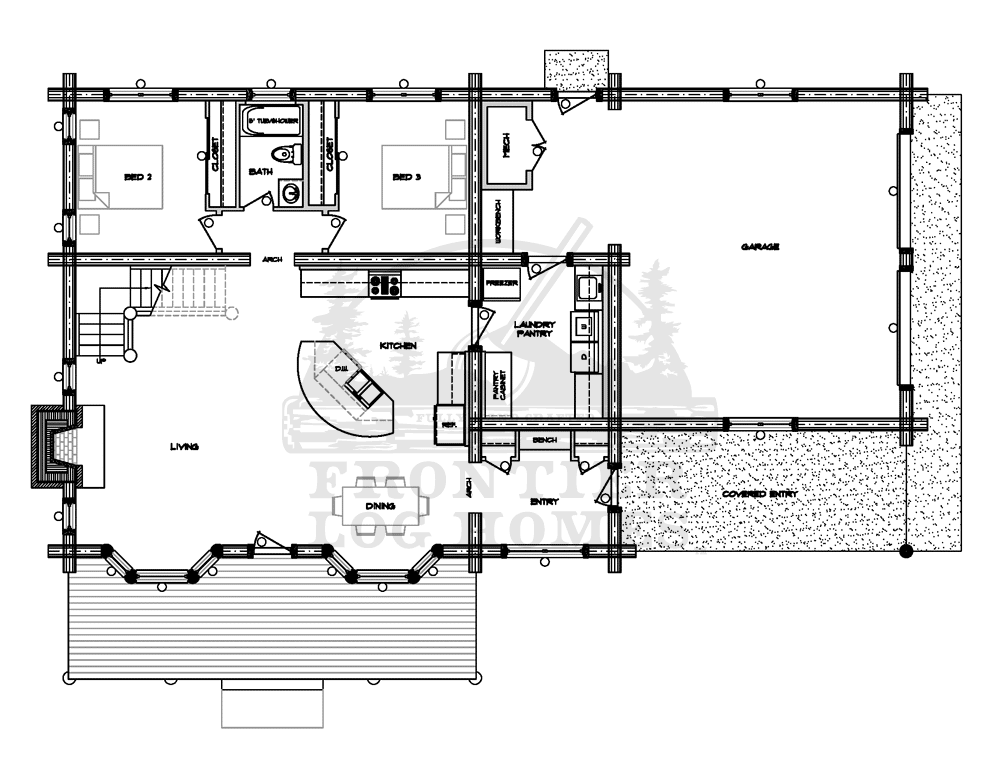
The best log cabin plans are the ones that match how you actually live, the land you are building on, and the budget you can finish with. Space, lifestyle, design style, location, and budget are the five things to weigh before you fall in love with a drawing. Get those five right and almost everything else is a detail you can change later.
Choosing between log cabin plans is genuinely hard, because a floor plan is the one decision that is expensive to reverse. Here is how we walk clients through it.
Five Questions to Answer Before Choosing Log Cabin Plans
Answer these five questions honestly before you look at a single drawing. Log cabin plans that fit the way you actually live beat plans that photograph well, every time.
1. How Much Space Do You Need?
Start with people, not square feet. How many people live in the home full time? How many guests do you actually host in a year, and for how long? Do you have pets, and do they need a place to come in muddy?
If the honest answers are “quite a few” and “yes,” you want log cabin plans with more square footage and a real transition space at the entry. If it is two people and an occasional weekend visitor, a smaller footprint with one flexible room will serve you better and cost far less to heat.
Square footage is also where the money is. You may be able to get a version of the plan you like as a log home kit rather than going through typical log home construction, which changes what size you can afford.
2. What Is Your Lifestyle Like?
People live in their homes very differently, and log cabin plans that suit one family are frustrating for another. Ask yourself a few specific questions:
- Where do I actually spend most of my time? That room deserves the best light and the most square footage.
- Do I need a mud room? In snow country the answer is almost always yes.
- Do I want to see the kitchen from the living room, or would I rather not?
- How much closet and gear storage do I really need? Log walls give you fewer places to hide it.
- Will anyone be working from home, and do they need a door that closes?
- Do I want to age in this house? If so, one bedroom and a full bath on the main level is not optional.
The last question changes more log cabin plans than any other. A loft bedroom is wonderful at forty and a problem at seventy.
3. What Is Your Design Style?
Do you prefer a modern, open layout, or something more compartmentalized with defined rooms? Do you want the building to read like a barn, a quaint cabin in the woods, or a timber manor? These aesthetics push square footage up or down on their own.
Furnishings matter more than people expect. Log walls are not flat, interior corners are often occupied by log ends, and a wall that looks generous on paper may not take the sofa you already own. Take real measurements of the furniture you plan to keep and check it against the plan before you commit.
Window placement is the other half of style. In log cabin plans, every window is a structural decision as well as a design one, because openings interrupt the log courses and need to account for settling.
4. Where Are You Building?
The land votes. Slope, solar orientation, prevailing wind, snow load, tree cover, and the direction of the view all shape which plans will work and which will fight the site.
On a sloped lot, a walkout lower level can add usable square footage for far less than building out. On a flat, exposed lot, that same plan means excavating a hole. Orientation matters just as much: putting the great room glass on the south side buys you free winter heat, while the same glass facing west can overheat the room every summer afternoon.
Local rules will narrow the field too. Snow load, wildfire mitigation setbacks, height limits, and septic siting all constrain the footprint before you draw anything. Most jurisdictions build on the International Code Council’s I-Codes, so check what your county has adopted early.
5. What Is Your Budget?
Budget is the constraint that decides everything else, and the mistake is to budget the shell rather than the finished house. The logs are a minority of the total. Site work, foundation, well and septic or utility connections, roofing, windows, mechanical systems, and interior finishes make up most of the number.
Simple, rectangular log cabin plans with a straightforward roof are dramatically cheaper per square foot than plans with multiple wings, dormers, and roof intersections. Every valley in a roof is a place that costs money to build and can leak later. If the budget is tight, buy simplicity and spend the savings on better windows and better insulation.
It also helps to browse by size. Look at our 1500 square foot and under floor plans, our 1500-2500 sq ft floor plans, our 2500-3500 sq ft floor plans, and our 3500+ sq ft floor plans to calibrate what a given budget actually buys.
Two Layout Decisions That Shape Everything Else
Once the five questions are answered, two structural choices drive the rest of your log cabin plans.
Open Concept or Traditional Rooms?
Open great rooms photograph beautifully and suit the way most people entertain. They are also harder to heat evenly, louder, and less forgiving if anyone in the house keeps different hours. Traditional log cabin plans with defined rooms are quieter, zone better for heating, and hide mess.
A middle path works for most families: one generous open living, dining, and kitchen space, plus at least one room with a door that is not a bedroom. That single closable room absorbs the office, the guest overflow, the hobby, and the noisy grandchild.
One Story or Two?
Single-story log cabin plans cost more per square foot because the foundation and roof are spread over a larger footprint, but they are cheaper to live in and vastly easier to age in. Two-story plans use land more efficiently and can capture a view from upstairs that the main level cannot see.
A loft is the compromise, and it is a good one in a cabin. It adds sleeping space and volume without a full second floor. Just be honest about the stairs, and remember that log homes settle, which means the stair connection has to be detailed to move.
How Log Cabin Plans Change When You Buy a Kit
A kit does not lock you into a catalog. Most of our clients start from an existing plan and modify it, which is faster and cheaper than starting from a blank page. What a kit does is set the log profile, the corner style, and the structural logic of the walls, and those decisions ripple through the plan.
Practical example: moving an interior wall in a stick-framed house is trivial. In a log home, if that wall is a bearing wall carrying a beam pocket in a log, the same change is a structural revision. This is why we like to have the plan conversation before the log package is finalized rather than after.
Five Common Mistakes in Choosing Log Cabin Plans
The same avoidable errors show up again and again:
- Choosing a plan from a photo without checking it against the site’s slope and orientation.
- Budgeting the log package and forgetting site work, utilities, and finishes.
- Undersizing the entry and mud room, then living with wet boots in the great room for thirty years.
- Putting all the glass toward the road instead of the view, or all of it west without shade.
- Designing for the family you have this year rather than the one you will have in fifteen.
Log Cabin Plans and Energy Performance
A floor plan is an energy decision before it is an aesthetic one. Compact shapes lose less heat than sprawling ones, because there is simply less exterior surface for the same interior volume. A two-story rectangle is the most efficient thing you can build; a single-story plan with three wings is the least.
Glazing is the other lever. South-facing glass under a properly sized overhang collects winter sun and rejects summer sun without any moving parts. North glass is a net loss almost everywhere. West glass is the hardest to manage, because low afternoon sun slips under every overhang you can reasonably build.
Log walls bring real thermal mass, which moderates daily temperature swings and makes a home feel steadier than its R-value alone would predict. That advantage only shows up if the rest of the envelope is tight, so pair good log cabin plans with a well-insulated roof and a serious air-sealing plan. The Department of Energy’s insulation guidance is a good starting reference for the roof and floor assemblies.
Take the Plan Outside Before You Sign
One habit saves more regret than any other: go stand on your land with the plan in your hand. Pace out the great room where it would actually sit. Look where the sun is at nine in the morning and at four in the afternoon. Notice where the wind comes from and where the snow will slide off the roof.
Then walk the drawing as a day. Come in the front door with an armload of groceries and see where you set them down. Get up at night and find the bathroom. Bring in firewood. Log cabin plans that survive that exercise are usually the right ones, and it costs nothing but an afternoon.
Frequently Asked Questions About Log Cabin Plans
Can log cabin plans be customized?
Yes, and nearly every client does. Modifying an existing plan is usually faster and less expensive than designing from scratch, because the structural logic is already proven. Changes that move bearing walls, roof lines, or window openings need to be reviewed against the log package.
What is a good size for a log cabin?
For a weekend or seasonal cabin, 800 to 1,500 square feet is comfortable for most families. Full-time homes usually land between 1,800 and 3,000. Larger is not automatically better in a log home, because the volume you are heating is greater than the floor area suggests.
Do I need an architect if I am buying a kit?
Not always, but you will need stamped drawings for permitting in most jurisdictions, and an engineer for the structure. We handle plan development and coordination for our clients, and bring in licensed professionals where the county requires it.
How long does it take to finalize a floor plan?
Usually four to twelve weeks of back-and-forth for a modified stock plan, and considerably longer for a fully custom design. It is worth taking the time. Changes on paper cost nothing; changes after the logs are cut cost a great deal.
Should the garage be attached to a log cabin?
In heavy snow country, a connected garage or at least a covered breezeway is a real quality-of-life upgrade. Detached garages are cheaper and reduce fire and fume risk, but you will carry groceries through the weather.
How do I plan for log settling in the layout?
Settling is handled with adjustable screw jacks at posts, slip joints at interior partitions, oversized rough openings at windows and doors, and slack at plumbing and electrical chases. Good log cabin plans account for all of it in the details, not as an afterthought.
Can I see the plans before I commit to a kit?
Yes. We would rather you spend serious time with the drawings than discover a problem during construction. Ask for the plan, walk it, and imagine a normal Tuesday morning in it.
Let’s Find the Right Log Cabin Plan for Your Land
When it comes to building your log home, Frontier Log Homes has helped families choose, modify, and build plans across the country for decades. Tell us about your site, your family, and your budget, and we will point you toward the log cabin plans that actually fit. Call us at 970-249-7130 to get started.