
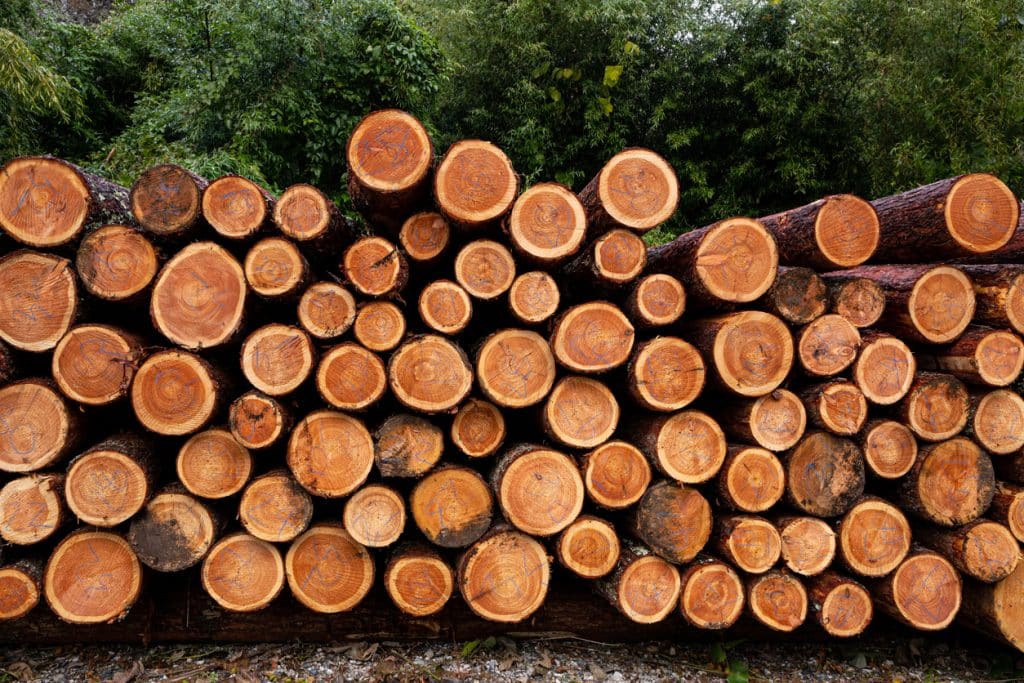
Choose handcrafted logs when you want full-diameter timber, one-of-a-kind character, and a wall where no two logs are alike; choose machine-milled logs when you want uniform sizing, a faster and more predictable build, and a lower cost per square foot.
Handcrafted logs are peeled and scribed by hand, so each log keeps its natural taper and every joint is cut to fit its neighbor. Milled logs run through a lathe or planer to a consistent profile, which makes assembly faster and the budget easier to hold. Both build homes that last for generations. The table below compares them across the seven differences that actually change your decision, and the sections after it explain each in detail.
Handcrafted Logs Versus Milled Logs at a Glance
| Factor | Handcrafted logs | Machine-milled logs |
|---|---|---|
| Log profile | Natural taper, full diameter, each log unique | Uniform diameter and profile throughout |
| Typical log diameter | 12-20 inches or larger | 6-12 inches |
| Joinery | Hand-scribed saddle or dovetail notches | Pre-cut tongue-and-groove with milled corners |
| Shell cost | Highest; heavy skilled labor content | Lower and more predictable |
| Build speed | Slower; shell is fitted piece by piece | Faster; components arrive numbered |
| Design freedom | Nearly unlimited spans, angles, and features | Constrained by the profile and system |
| Thermal mass | Greater, from more wood volume | Less, though easier to pair with added insulation |
| Settling behavior | More movement as large logs dry | Less, especially with kiln-dried stock |
| Best fit | Legacy homes, lodges, showpiece great rooms | Kits, budget-conscious builds, faster schedules |
There is something exceptionally cozy, rustic, and American about log homes, and their rising popularity points to this end. According to the Log Homes Guide, there were about half a million log home buildings as of 2006 [1]. Additionally, log cabin sales have consistently grown since 1995 [2].
It can be a challenge, especially for the uninitiated, to decide whether milled logs are as suitable as handcrafted logs when constructing their log homes. If you hope to switch to the log cabin lifestyle, it is imperative to understand that while log homes can be uniquely beautiful, they require an intricate construction approach. Choosing between machine-milled and handcrafted logs is the most important choice you will have to make before embarking on a log home-building construction project.
Machine-Milled Versus Handcrafted Logs: The Core Differences
Handcrafted logs for cabins are hand-selected, peeled, scribed, and placed by a human log crafter. The crafter ensures that each log is well-scribed to fit nicely onto the adjacent log. Since each log is crafted by hand, the log cabin building is essentially pre-assembled until the house is complete. The logs are then marked and disassembled for delivery. Handcrafted log home companies also provide floor plan options to prospective clients, but the homeowner can easily introduce new modifications to the design layout because the logs are custom-built.
Milled logs for cabins are sawed to meet a uniform shape and size. Milled log home companies usually deliver the logs in bundles with the applicable construction instructions. Typically, the log cabin owner selects the floor plan design and the log style they prefer. The log home company then packages and ships the logs to the construction site. Homeowners may then assemble the logs themselves or hire a contractor to do the job. Unlike handcrafted log homes, the homeowner can implement very few modifications to the design plan they chose earlier.
Below are more differences between machine-milled and handcrafted logs.
Difference 1: Construction Process
Before constructing a milled log home, dead logs are cut and taken to the log mill for sorting by size, shape, and diameter. At the log mill, each log is sawed to ensure that the pieces have a uniform profile and shape. Given that every log is made to fit uniform specifications, the constructor can place any log at any point in the cabin. This feature eliminates the need to pre-assemble the log cabin before shipping.
Before constructing a handcrafted log home, dead logs are hand-sorted at the log mill. The logs are then sent to the hand-crafting section, where they are draw-knifed and trimmed. This process helps to preserve the distinctive look of each log. The logs are then assembled before shipping to the construction site.
Difference 2: Cost
Generally, handcrafted log homes are more expensive than machine-milled log cabins. This difference in cost speaks to the amount of time and human effort needed to prepare each log and assemble the log cabin before shipping. However, these increased expenses are worth every penny in light of handcrafted logs’ unique aesthetics and design flexibility.
Difference 3: Design Freedom
Handcrafted logs are more suitable for those who wish to have control over the design layout of their log cabin. Handcrafted logs are very customizable, which allows log cabin owners to introduce new additions to their design layout. Additionally, having an infinite number of customizable floor plans to select from makes the design process much more fulfilling.
Milled logs do not afford as much flexibility in design. Machine-milled kits may present some limitations to the design, and having a limited number of design options makes the design process less enjoyable. Perhaps the biggest drawback to machine-milled logs is that prospective log cabin owners cannot easily change the look of their log homes to reflect their preferences.
Difference 4: Insulation and Energy Performance
Handcrafted logs carry more wood volume, and wood has meaningful thermal mass. A large-diameter wall stores heat during the day and releases it at night, which flattens temperature swings in a way that an R-value on paper does not capture. Milled walls have less mass but are simpler to pair with insulated roof and floor assemblies, so a well-detailed milled home can perform just as well overall.
Either way, the logs are only part of the envelope. Air sealing at corners, window bucks, and the top plate does more for comfort than log diameter alone. Our pages on cabin insulation and energy efficiency in log homes cover the assemblies we use at elevation.
Difference 5: Settling and Long-Term Maintenance
Every log wall moves as the wood reaches equilibrium moisture content. Handcrafted logs are larger, so they shed more water and settle more, often an inch or more over the first few years. Good builders plan for it with settling jacks at posts, slip joints at partition walls, and oversized openings above windows and doors. Milled logs, especially kiln-dried, move less.
Maintenance is similar for both. Both need a maintained exterior finish, sound sealant at joints, and annual inspection. Handcrafted logs have more exposed end grain and deeper checks, which means a bit more attention at the log ends. For the full picture, see log home settling and log home maintenance.
Difference 6: Schedule and Predictability
A milled package arrives numbered, and an experienced crew can stack a shell in a matter of weeks. Handcrafted shells are fitted log by log, often pre-assembled at the yard, then disassembled and reset on site. That craft takes time, and the schedule depends on the crew rather than a delivery date.
Predictability matters if you are financing construction, because interest accrues on the schedule. It matters less if the cabin is a legacy project you intend to keep for decades. If you want speed with the log look, our hybrid log home approach mixes log elements with conventional framing to hit a tighter timeline.
Difference 7: Resale Value and Buyer Appeal
Handcrafted homes attract a smaller but more motivated pool of buyers, and a genuinely well-built handcrafted lodge can command a premium that milled construction rarely reaches. Milled homes sell to a broader market and appraise more easily because comparable sales are simpler to find. Condition beats construction method in both cases. Our guide on whether log homes hold their value walks through how appraisers treat each.
Advantages of Handcrafted Logs
As mentioned earlier, handcrafted logs are uniquely crafted to meet customer-centric preferences. The logs are trimmed carefully to retain the natural feel and look of the trees from which they were made. Needless to say, a few upsides are associated with using handcrafted logs for your log home. Below are three of the most appealing benefits of handcrafted log homes.
Unique Beauty You Cannot Reproduce
Handcrafted log homes are increasingly becoming more popular nationwide because they connect us with the beauty of our rich history. Log cabins remind us of past generations who built their homes with nothing more than a saw and sheer determination.
Opting for handcrafted logs means you will be ushering in the raw beauty of the American frontier into your home. Each log brings the unique and natural qualities of the tree from which it was cut. Since each log is tapered and hand-hewn, it will showcase this hand-peeling and the tools used to produce its beauty.
Moreover, depending on your architectural preferences, you may have your most beautiful logs in such areas where they will stand out and magnify your home’s artistic appeal.
Customizable Design and Layout
Design customization is the main benefit of using handcrafted logs. Since each log is selected by hand and cut to fit desired specifications, home constructors and architects can enjoy increased control over the floor plan of their log cabin home. Handcrafted logs may be the better choice if you wish to have a unique log home building.
Durability From Full-Diameter Timber
Like most pioneer buildings across the US, your handcrafted log home can stand strong and proud for a long time. Without a doubt, the thick natural logs mean that your log cabin can act as a solid fortress between your loved ones and the harsh world outside.
Many people might be surprised by this unique fact: that log homes can be more durable than some stone-walled buildings. Since trees can survive unfavorable weather conditions, it is easy to see where handcrafted log cabins derive their durability. Without question, well-constructed log homes can withstand environmental challenges, including tornadoes and storms.
How to Choose Between Handcrafted Logs and Milled Logs
At the end of the day, choosing between a handcrafted and a machine-milled log cabin boils down to your taste, budget, and timeline. As mentioned earlier, milled logs offer a straightforward construction process less likely to attract hidden expenses. On the other hand, handcrafted log homes are more expensive to construct, but they make up for this with better aesthetics and superior artistic appeal.
Go for a handcrafted log home if you wish to have full control over the design of your log cabin. Handcrafted logs offer more flexibility in design and layout, which affords prospective homeowners a chance to implement their preferences to the letter.
A machined-milled log cabin is the better choice if your main concerns revolve around cost. Handcrafted log cabins are typically more expensive because more human labor and skill go into constructing these log homes.
Which Species Suits Handcrafted Logs Best?
Handcrafted work rewards species that grow large, straight, and stable. Engelmann spruce, lodgepole pine, Douglas fir, and western red cedar are the usual choices in the Rockies and the Northwest. Dead standing timber is prized because it has already dried on the stump, which reduces later movement.
Milled systems work with a broader range, including smaller-diameter pine and spruce that would never yield a good handcrafted log. Species choice affects insect resistance, decay resistance, weight, and cost. See the best type of wood for a log home for a species-by-species breakdown.
How Handcrafted Logs Fit Into Kits and Custom Builds
Most log home kits are milled, because a kit depends on repeatable parts and predictable freight. That is not a compromise so much as a different product: our log home kits deliver an engineered shell package with a known price, which is exactly what many buyers want.
Handcrafted logs generally belong in a custom log home build, where the design and the timber are developed together. Many owners land in the middle, using handcrafted elements such as a scribed-corner great room, exposed trusses, or full-diameter posts inside an otherwise milled or hybrid structure. Our custom home design process is built around exactly that kind of blend.
Handcrafted Logs FAQ
Are handcrafted logs worth the extra cost?
They are if the character of the wall is the reason you want a log home. You are paying for skilled labor and larger timber, and the result cannot be reproduced by a machine. If your priority is square footage or schedule, milled logs put your money to better use.
Do handcrafted logs last longer than milled logs?
Not inherently. Longevity comes from keeping water out, which means overhangs, drainage, a maintained finish, and sound sealant. Larger logs give you more material to lose before problems become structural, but a well-maintained milled home outlasts a neglected handcrafted one every time.
How much more do handcrafted logs cost?
Expect the shell to run meaningfully higher than a comparable milled package, with the gap driven by labor hours and timber size rather than by a fixed percentage. Get quotes on the same floor plan both ways; the difference is site-specific and worth seeing in real numbers.
Can you tell handcrafted logs from milled logs by looking?
Usually, yes. Handcrafted walls taper, each log differs in diameter, and the corners show scribed saddle notches that wrap the log below. Milled walls show consistent diameters, uniform courses, and machined corner profiles.
Do handcrafted logs settle more?
Yes, because there is more wood to dry. A competent builder designs for it. Problems appear when settling is ignored, not when it happens, so ask any builder to show you their settling details before you sign.
Which style of log home suits handcrafted logs?
Full-scribe and saddle-notch designs, lodge-style great rooms, and anything with heavy exposed trusses. Our overview of log home styles shows which styles depend on handcrafted work and which do not.
Can handcrafted logs be used in a small cabin?
They can, though large logs eat interior space and can overwhelm a small room. Under about 1,200 square feet many owners prefer milled logs or a hybrid approach and put the handcrafted budget into one dramatic space instead.
Talk to a Builder Who Does Both
Frontier Log Homes has been building in Montrose, Colorado since 1977, using handcrafted logs, milled packages, timber frame, and hybrid construction. That range matters, because a company that only sells one system will always recommend it. We would rather look at your site, your plan, and your budget and tell you honestly which approach fits.
Contact us to talk through handcrafted logs versus milled logs for your project, or start with our frequently asked questions if you are still in the research stage.
References and Further Reading
- USDA Forest Service, Forest Products Laboratory research on wood durability and moisture performance: research.fs.usda.gov/fpl
- National Association of Home Builders, Log and Timber Homes Council green building guidance: nahb.org log homes council
- U.S. Department of Energy, building envelope and insulation guidance: energy.gov insulation