
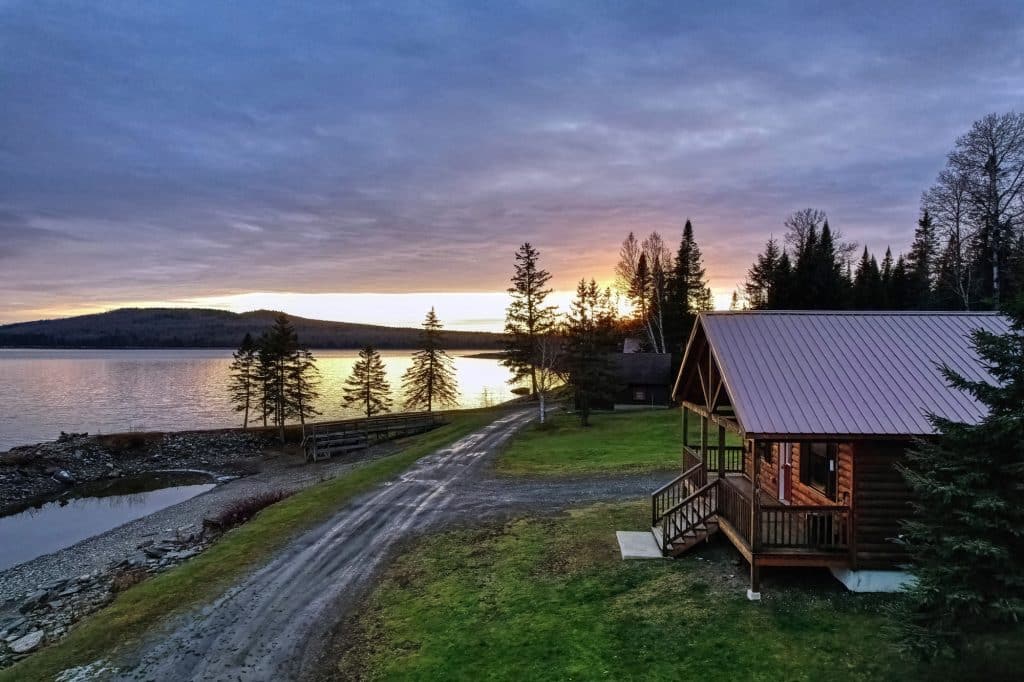
The cabin is rarely the expensive part of an off grid build. The infrastructure is. Power, water, septic, and the road to reach all three routinely account for a third of the total, and none of it shows up in a plan you bought online.
Here is what off grid cabins in Colorado actually require, in the order the money leaves your account.
Key Takeaways
- Access comes first. If a concrete truck cannot reach the site, everything downstream changes — including the foundation type.
- Water is a permit, not a hole. Colorado well permits are issued by the state and the rules vary by basin.
- Solar is sized for January, not July. A system sized for summer sun leaves you running a generator in the dark half of the year.
- Septic still applies. Off grid does not mean unregulated. County environmental health reviews the system like any other.
- Design decides all of it. Orientation, roof pitch, and where the mechanical room sits are set on paper, long before anything is installed.
What This Guide Covers
- What off grid actually means in Colorado
- Seven costs nobody warns you about
- The four systems and what drives their price
- Why access is the first line item
- Permits you still need
- Design decisions that make or break an off grid cabin
- How Frontier Log Homes builds remote
- Frequently asked questions
What Off Grid Actually Means in Colorado
Off grid means no utility connection: no power drop, no municipal water, no sewer. It does not mean no rules. Off grid cabins in Colorado are permitted, inspected, and code-reviewed like any other dwelling, and in most mountain counties they face wildland-urban interface requirements on top of that.
The practical definition is simpler. You are building a small utility company alongside a house, and you are the one maintaining it. That is the trade: no monthly bill, but every system is yours.
The people who love it are the ones who understood the trade before they signed. The ones who regret it are the ones who priced the cabin and assumed the rest was minor.
Seven Costs Nobody Warns You About
- The road. Grading, culverts, base course, and drainage on a mountain driveway can rival the cost of the foundation. It also has to carry a concrete truck and a crane, not just your truck.
- Well drilling depth. You pay by the foot, and the foot count is unknown until you drill. Neighboring wells give you a range, not a guarantee.
- Winter solar production. Panels lose output in the low, short days of December and January. Sizing for that window — not for June — is what keeps you off the generator.
- Battery replacement. Batteries are a consumable with a service life. Budget the second set at the beginning, not when the first set fails.
- Propane logistics. Tank size is dictated by how often a truck can reach you. Remote sites need more storage, which means a larger tank and a bigger pad.
- Freeze protection. Buried lines below frost depth, heat trace, insulated mechanical space, and a plan for what happens if you leave in February.
- Getting materials there. On difficult parcels the delivery method itself is a line item. We have built where the only viable option was helicopter delivery.
The Four Systems and What Drives Their Price
| System | What Drives the Cost | The Decision That Matters Most |
|---|---|---|
| Power | Winter production target, battery capacity, generator backup | Size for December load, not annual average |
| Water | Well depth, pump type, storage volume, freeze protection | Confirm the permit and likely depth before you close on the land |
| Wastewater | Soil percolation, slope, setbacks from wells and drainages | A failed perc test can move the house, not just the septic field |
| Heat | Envelope performance, fuel logistics, backup source | Insulate first — every dollar in the envelope shrinks every system after it |
Notice the pattern. Every one of those decisions is made during design, and every one of them changes the building itself.
Why Access Is the First Line Item
Access is evaluated before the floor plan on any remote site, because it sets the boundaries for everything else.
If a concrete truck cannot reach the building envelope, the foundation strategy changes. If a crane cannot set up, the framing approach changes. If material has to be staged and shuttled, labor hours climb. On the hardest parcels the answer is air delivery, which is expensive but often cheaper than building a road that meets grade.
This is also the most common reason an off grid budget doubles between the first conversation and the first invoice. The land was affordable precisely because reaching it is not. Our guide to buying land to build a house covers what to check before you close.
Permits You Still Need
- Building permit from the county, with a full construction set and structural engineering.
- Well permit from the Colorado Division of Water Resources. Rules differ by basin, and household-use-only permits carry real limits.
- Onsite wastewater permit from county environmental health, usually requiring a soil evaluation.
- Driveway or access permit where the drive meets a county road.
- Wildfire mitigation review in wildland-urban interface zones, which can dictate roofing, siding, decking, and defensible space.
None of these are waived because a cabin is small or remote. Several take longer to obtain than the permits on a conventional in-town home.
Design Decisions That Make or Break an Off Grid Cabin
| Decision | Get It Right | Get It Wrong |
|---|---|---|
| Orientation | Winter sun into living space, panels facing production | A cold, dark house and a generator running at noon |
| Envelope | Smaller systems, smaller battery bank, lower fuel use | Every mechanical system oversized to compensate forever |
| Roof pitch and shed direction | Snow sheds away from doors, panels, and propane | Blocked exits and damaged equipment every spring |
| Mechanical room | Conditioned, accessible, sized for batteries and future service | Equipment in a crawlspace nobody can reach in February |
| Water storage location | Inside the thermal envelope | A frozen tank and a split line |
How Frontier Log Homes Builds Remote
Frontier Log Homes has designed and built custom log and timber homes out of Montrose, Colorado since 1977. Remote and difficult-access work is a normal part of what we do, not an exception we take on reluctantly.
That includes parcels reached only by helicopter, sites at elevations where the build season is short, and ground steep enough that most crews decline the drive. The value of that experience is early honesty: we can tell you in the first conversation whether a parcel supports what you want to build, before you have paid anyone to draw it.
Off grid cabins in Colorado reward planning more than almost any other kind of project. The design phase is where that planning happens.
Frequently Asked Questions
Are off grid cabins in Colorado legal?
Yes. Off grid cabins in Colorado are legal and are permitted, inspected, and code-reviewed like any other dwelling. You still need a building permit, a well permit from the state, an onsite wastewater permit from the county, and in many mountain counties compliance with wildland-urban interface wildfire requirements.
Can I drill a well anywhere in Colorado?
No. Well permits are issued by the Colorado Division of Water Resources and availability depends on the basin, the parcel size, and existing water rights. Household-use-only permits carry real restrictions on outdoor use and livestock. Confirm well availability before you buy land, not after.
How much of an off grid budget goes to infrastructure?
On remote mountain parcels, roughly a third of total project cost commonly goes to access, power, water, and wastewater before any framing begins. The harder the access, the higher that share climbs. This is the single most underestimated number in off grid building.
Is solar enough, or do I need a generator?
Most Colorado off grid systems pair solar and batteries with a generator for backup. Winter production drops sharply with short days and low sun angle, so systems sized around December load need less generator run time. Systems sized around annual averages need more.
Do off grid cabins need septic systems?
Yes, in nearly all cases. County environmental health reviews and permits onsite wastewater systems, usually after a soil evaluation. A failed percolation test can force the house to move on the parcel, which is why testing happens during design rather than after.
Can you build on a parcel with no road access?
Sometimes. The options are building an access road that meets grade requirements, staging and shuttling material, or air delivery. We have completed builds using helicopter delivery where no viable road existed. Which option applies is a site-specific question answered during design.
Let’s Design a Log Home That Fits Your Land, Budget, and Lifestyle
Send us the parcel and what you want to build on it. We will tell you what the access, water, and power realities are before you commit to a plan.