
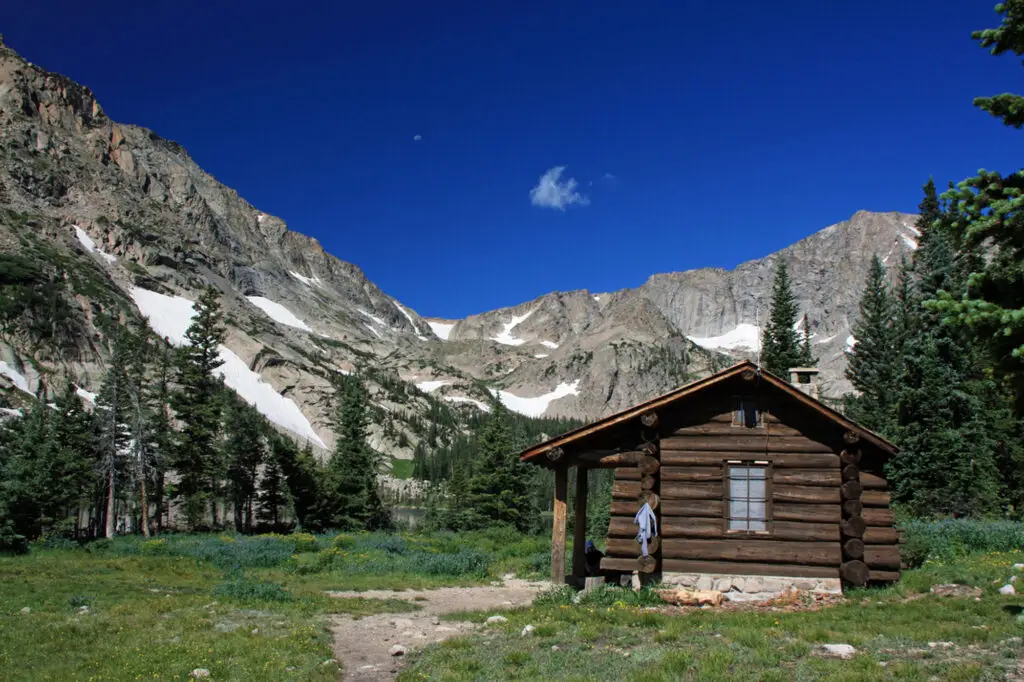
Colorado does not issue a statewide general contractor license. That single fact explains most of the variation among log cabin builders in Colorado: authority to build comes from the county or the town, not the state, so two companies advertising the same service can be held to completely different standards on opposite sides of a county line.
We have built log and timber homes on the Western Slope since 1977. What follows is what we would check if we were the ones hiring.
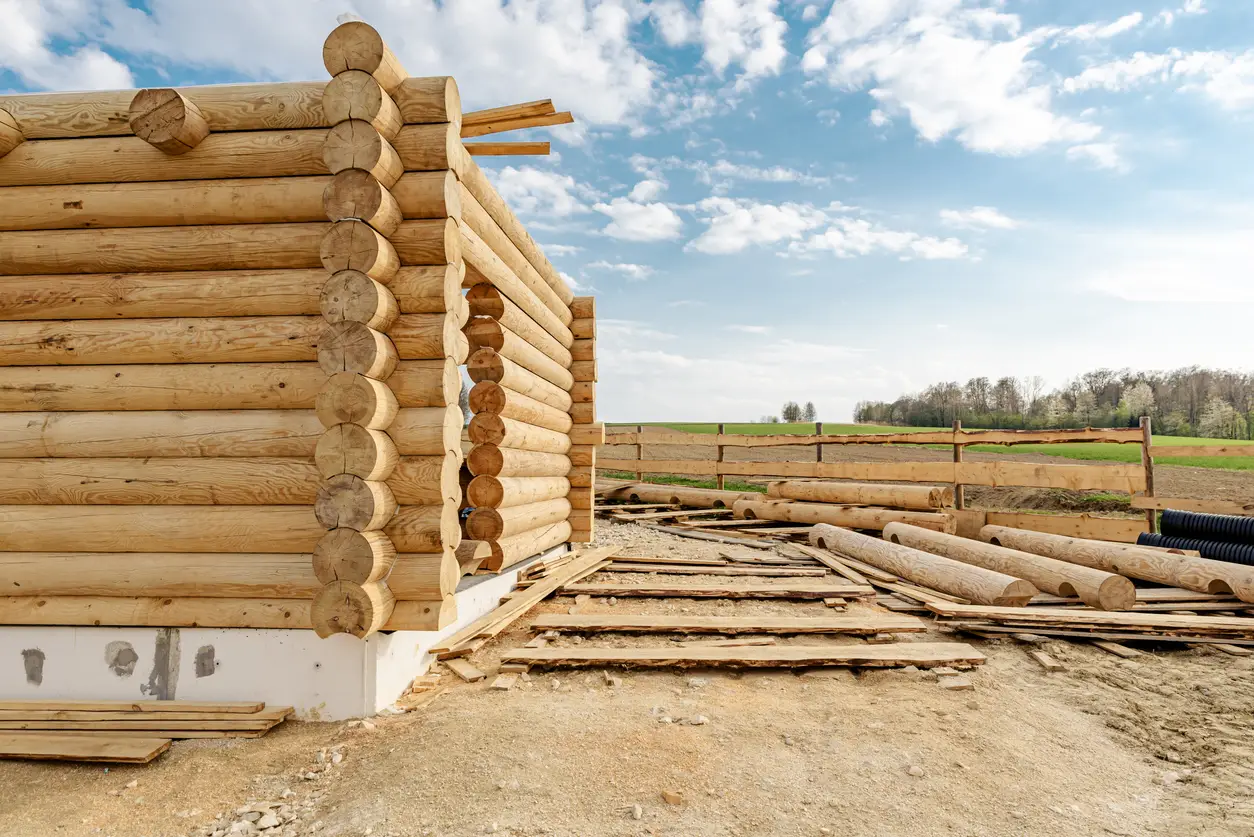
What to verify before you hire log cabin builders in Colorado
Work through these in order. The first four disqualify more companies than the last five.
- Local licensing and registration in the specific county or town where your lot sits.
- General liability and workers’ compensation insurance, confirmed by certificate sent directly from the insurer.
- Log-specific structural experience — not conventional framing with a log accent wall.
- Mountain site experience at your elevation, on your kind of access.
- Who actually holds the contract — the builder, a package supplier, or a dealer.
- Whether design and construction live under one roof or you coordinate them yourself.
- Completed projects you can visit, not renderings.
- References from owners who finished three or more years ago.
- How the contract handles change orders, allowances, and weather delays.
Licensing for log cabin builders in Colorado is local
The state licenses electricians and plumbers through the Colorado Department of Regulatory Agencies. It does not license general contractors. Counties and municipalities do that themselves, and their rules are not uniform. One county may require an exam, proof of experience, and a bond. The next may require far less.
So “licensed and insured” means nothing until you know where. Ask which jurisdictions the company is currently registered in, then confirm it with that building department yourself. It takes one phone call. Log cabin builders in Colorado who work across several counties should be able to answer without checking.
Insurance deserves the same treatment. Ask for the certificate to come from the insurance agent, not from the builder’s files. A lapsed policy still prints.
Structural standards matter here too. Log walls are covered by their own referenced standard, ICC 400, Standard on the Design and Construction of Log Structures, which addresses how log walls are designed, graded, and detailed for settling. A builder who has never heard of it is telling you something. Snow, wind, and soil loads are set by your county and by the geotechnical report on your lot, and our overview of building codes for log homes covers where that usually creates friction.
Four kinds of companies call themselves log cabin builders in Colorado
They are not interchangeable, and the difference decides who is responsible when something goes wrong.
| Type | What they actually sell | Who carries the risk |
|---|---|---|
| Kit or package dealer | A materials package, shipped to your site | You. Assembly, subcontractors, and schedule are yours to arrange. |
| Log producer | Logs cut, milled, or handcrafted to a plan | Split. They warrant the material, not the finished house. |
| General contractor | Construction management and subcontractor coordination | The contractor, for construction. Design usually sits elsewhere. |
| Design-and-build log home builder | Design, engineering coordination, and construction under one contract | One company, start to finish. |
None of these is wrong. A dealer package is a reasonable choice for an owner-builder with time and a flat, accessible lot. The mistake is assuming you bought the fourth row and discovering you bought the first. Read what the contract covers, then read what it excludes. Our comparison of turn-key log home contracts lays out where the scope lines usually fall.
Frontier works as row four. We hold a general contractor license and build our own designs, which is why the general contracting side of the business and the log home side are the same crew.
Mountain ground narrows the field fast
Most buildable log home lots in this state are not flat, not close to a paved road, and not next to a power pole. That is where the list of qualified log cabin builders in Colorado gets short.
Ask any candidate how they would handle four things on your specific lot:
- Access. A log package arrives on long trailers, and a crane has to reach the wall it is setting. Grade, width, and turning radius decide whether that is possible or whether material has to be staged and moved twice.
- Season length. Excavation, concrete, and log setting all have weather windows. At elevation, missing one can move a project a long way.
- Utilities. Well, septic, and either a power line extension or an off-grid system. These are design decisions, not afterthoughts, and they price very differently.
- Slope and soils. A view lot often means retaining walls, deeper foundations, longer utility runs, and a switchback driveway. Our guide to sloped lots versus flat lots covers what to check before you close on land.
A builder who answers these in generalities has not built on ground like yours. A builder who answers in specifics — and names what they would want to see before quoting — has.
Some sites cannot be reached by road at all. We have staged builds where material had to be flown in. That is unusual, and it is the reason certain lots are buildable in the first place. When you compare log cabin builders in Colorado, ask each one for the hardest site they have finished and what made it hard.
Design first, price second
The most common way a log home project goes wrong is that it gets priced before it gets designed. Numbers quoted against a stock plan and an unseen lot are guesses, and guesses get corrected upward once real conditions surface. Log cabin builders in Colorado who quote before they draw are pricing a house they have not seen.
A plan drawn for logs is not the same as a plan drawn for framing. Log walls are structural, they carry loads differently, and they move as the logs give up moisture. Detailing at every window, door, stair, and interior partition has to allow for that movement. A conventional plan handed to a log builder usually has to be redrawn.
That is what a custom home design engagement produces: a floor plan, elevations, and a structure a builder can price accurately.
How to compare bids that are not comparable
Once you have drawings, bids become useful. Without them, you are comparing assumptions.
Put every proposal side by side and check four lines before you look at the total. What is the allowance for finishes, and is it realistic. What site work is included, and what is excluded. Who carries the cost of a weather delay. How change orders are priced — a percentage, a fixed markup, or time and materials.
Two proposals from log cabin builders in Colorado can differ by a wide margin and both be honest. The gap is usually scope, not greed. Our breakdown of how general contractors charge explains cost-plus, fixed price, and where allowances hide risk.
Proof beats claims
Anyone can publish renderings. Ask for three things instead. The strongest log cabin builders in Colorado offer all three before you ask.
Finished houses you can see. Photographs of completed work on real terrain tell you more than any brochure. Our project gallery shows the range of sites we have built on.
Old references, not new ones. An owner three years in knows how the roof sheds, how the windows behaved through settling, and whether the builder came back. An owner three months in only knows whether the crew was polite. Our client reviews are the long-term version of that question.
Time in business, in this climate. Mountain building punishes inexperience slowly. Companies that have worked one region for decades have already made the expensive mistakes. Frontier has been at it since 1977.
If your project sits near Montrose, Ouray, Ridgway, or Telluride, our guide to custom home builders in Montrose covers the local version of this question, and hiring a general contractor in Colorado covers the statewide one.
Frequently asked questions about log cabin builders in Colorado
Do log cabin builders in Colorado need a state license?
No. Colorado has no statewide general contractor license. Licensing and registration are handled by counties and municipalities, so requirements change depending on where your lot is. Electricians and plumbers are licensed at the state level. Verify a builder’s standing with the building department that has jurisdiction over your property.
How do I check whether a builder is legitimate?
Call the building department for your county and ask whether the company is registered and in good standing. Ask the builder’s insurance agent to send certificates directly to you. Then ask for references from owners who moved in at least three years ago, and call them. Do this for every one of the log cabin builders in Colorado on your shortlist. Our list of questions to ask a general contractor covers the rest of the interview.
Should I hire a builder or buy a kit?
It depends on your lot and your time. A kit can work on accessible, level ground when the owner is prepared to manage subcontractors and the schedule. Steep grade, difficult access, heavy snow, or an unusual footprint usually make a designed-to-site build the better path, because modifying a kit to fit hard ground erases the savings.
How many log home builders actually work in this state?
Fewer than the search results suggest. Many companies listed for Colorado are national kit suppliers with dealers here rather than crews. Ask where the crew is based, who employs them, and which projects in the portfolio that crew actually built.
What should log cabin builders in Colorado tell me about my land before quoting?
Whether it can be built on, and at what added cost. Access, water, septic feasibility, power distance, zoning, setbacks, and slope all move the number more than square footage does. A builder who quotes a price per square foot before seeing the property is quoting a house, not your house.
Can one company handle design, permitting, and construction?
Yes, and it removes the most common source of delay. When design and construction sit with separate firms, the coordination gaps land on you. A single contract puts drawings, engineering coordination, permitting, and the build under one point of accountability. That is how our custom log home process is structured.
Start with your land
Every project we have finished since 1977 started the same way: look at the site, understand what it allows, then design to it. Builders who skip that step produce the surprises that show up later as change orders. It is the shortest test there is for separating log cabin builders in Colorado who will finish from those who will not.
If you own land or are about to buy it, we will tell you straight what it will and will not support — before you spend anything. Call (970) 249-7130 or send the details through our contact form.
Let’s design a log home that fits your land, budget, and lifestyle.