
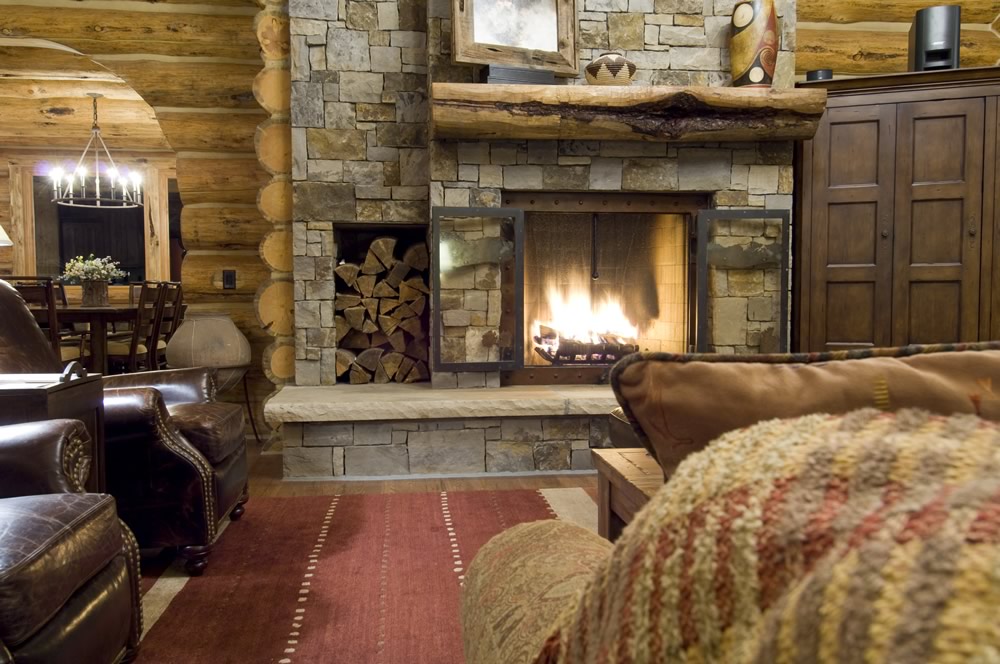
The three fireplace ideas worth considering in a log home are wood, gas and electric, and the right one depends on how you will actually use it. Wood gives real heat, real sound and real work. Gas gives instant fire and almost no maintenance. Electric is inexpensive and easy but never convincing. In a log home the choice also drives framing, chimney routing and settling allowances, so decide before the plans are finished. Frontier Log Homes has been handcrafting custom log homes in Montrose, Colorado since 1977.
A fireplace is a cozy, traditional addition to any home, and most fireplace ideas start with picking a fuel. Depending on the type you choose, there are things you should settle before this piece goes into the plan for your log home. What are the advantages and disadvantages of each?
Wood-Burning Fireplace Ideas
Wood-burning fireplace ideas add a rustic look and feel to your living room. However, you may need special additions in order for it to properly heat your house.
Pros
- Using electricity isn’t an issue. With a wood fireplace, you can cook and heat your house without a problem.
- You choose the wood. Some give off nice aromas, where others can burn for different lengths of time.
- There’s a general aesthetic. Using real wood gives your home an authentic atmosphere with both the smell and sound that will fill your home.
Cons
- It is generally more to maintain. You have to constantly tend to the fire, even when the fire is out and the ashes are warm. It can also become unsafe when your fireplace is not consistently maintained and inspected.
- You have to split the wood. Some people enjoy the rustic charm that comes with splitting their own firewood, but you will need to have a good supply of logs ready to be put on the fire. Not only will you have to split a lot of logs, but you’ll also need to have somewhere dry and safe to store them all. Plus there is the cost of the wood itself.
- Overall efficiency. Even though a natural fireplace may decrease costs in some areas, it may also let drafts enter or escape. Overall, they are not efficient at heating as a stand alone wood or pellet burning stove.
Gas Fireplace Ideas
These fireplaces are useful for busy people who still want a natural appearance with their fireplace.
Pros
- You get instant fire! You don’t have to split wood or hassle with matches to get warm.
- There’s not much maintenance. There is no ash cleanup; though you will need to inspect it every once in a while, inspection is not as much of a priority as it is with real wood-burning hearth.
- They can be more energy efficient. You can cut long-term costs by turning on the fire and using special appliances to spread the heat around your home.
Cons
- Installation can be expensive! It’s cheaper in the long run, but the initial costs are pretty pricey.
- They aren’t quite the real thing. They do not have the same look and feel of a wood burning unit.
Electric Fireplace Ideas
Electric fireplace ideas provide both heat and light and often use an animated fire once plugged in.
Pros
- Your just need to plug them in. They are portable and have an easy installment.
- They are good for small spaces. If you have a smaller home or a small room or hallway that needs heated, an electric fireplace can be a huge benefit!
Cons
- The fire isn’t real. If you want a fireplace for the ambiance, electric hearths use animations of fires rather than real ones. Some come with sound effects, but they are still clearly fake.
- There are limited styles. If you are wanting a fireplace with a unique look, you won’t find it with an electric option.
- They don’t work when your electricity is out. If you need heat but the electricity is out, there won’t be much you can do.
What Makes Fireplace Ideas Different in a Log Home
A log wall settles. Even kiln-dried logs give up some moisture, and handcrafted logs settle more. A masonry chimney and a stone hearth do not move at all. Where those two systems meet, the plan has to allow the logs to drop past the masonry without binding, cracking the stone or opening a gap at the flashing. That detail is engineered on the drawings, not solved on site.
Three more log-specific points shape fireplace ideas. Clearance to combustibles is measured to the logs themselves, and solid wood walls change the math compared with a framed and drywalled room. Chase routing has to be planned before the shell is cut, because you cannot casually core a bearing log later. And thermal mass helps you: log walls hold the heat a fireplace produces and release it slowly, which is why a modest firebox goes further in a log home than in a frame house. Our breakdown of the R-value of wood explains why.
Stone, Surround and Hearth Fireplace Ideas
Once the fuel is settled, the fireplace ideas that shape the room are all about the surround.
The firebox is the mechanical decision. The surround is the one everyone actually looks at. Full-height dry-stacked stone running to a vaulted ceiling is the classic mountain look and the heaviest, which means the foundation has to be sized for it from the start. A raised hearth doubles as seating and keeps the fire visible from a sofa. A reclaimed timber mantel ties the fireplace back to the walls. Simple plastered surrounds are having a moment and cost a fraction of full masonry.
Whatever surround you choose, place the fireplace where it will actually be used. In an open plan, a fireplace on an interior wall heats the house better than one on an exterior gable, and it keeps the chimney inside the thermal envelope so it drafts properly on cold mornings.
Efficiency and Safety Behind the Fireplace Ideas
An open masonry fireplace is a poor heater. Most of the warmth goes up the flue, and it can pull conditioned air out of the house while it burns. If heat output matters more than the look of an open fire, an insert or a certified wood stove will deliver several times the usable heat from the same firewood. The EPA Burn Wise program publishes efficiency comparisons and guidance on cleaner-burning appliances.
Whatever you install, plan for annual chimney inspection and cleaning, working smoke alarms on every level, and a carbon monoxide alarm near the sleeping areas if you burn anything. Clearance, hearth extension and flue sizing are all code items, and standards published by the National Fire Protection Association are what your inspector will be working from. Our guide to navigating building codes covers the review process, and log cabin heating compares a fireplace with the other ways to warm a cabin.
Fireplace Ideas FAQs
What is the best fireplace for a log cabin?
For real heat and no dependence on utilities, a wood stove or a certified wood insert. For convenience, gas. An open masonry fireplace is the best-looking and the least efficient of the three, which is a perfectly reasonable trade if you want it for atmosphere.
Can you put a fireplace in a log home?
Yes, and most log homes have one. It simply has to be designed in from the beginning so the chimney chase, the hearth foundation and the settling allowances are all on the drawings.
Do gas fireplaces work in a power outage?
Many do, if they use a standing pilot or a battery backup for ignition. Models that rely on an electric blower will still light but will move much less heat. Ask before you buy if outages are common where you are building.
How much does a log home fireplace cost?
An electric unit is the cheapest by a wide margin. A gas insert lands in the middle. A full masonry fireplace with a stone chimney is usually the single most expensive feature in the great room, because you are paying for the foundation and the stonework as much as the firebox.
Are wood fireplaces allowed everywhere?
No. Some mountain and valley communities restrict new wood-burning appliances for air quality reasons, or allow only EPA-certified units. Check with the county before you finalize your fireplace ideas.
Where should the fireplace go in a log home?
On an interior wall when you can. It keeps the flue warm, improves draft, radiates heat into the house instead of through an exterior wall, and usually gives a better furniture layout in an open floor plan.
Talk Through Your Fireplace Ideas Before the Plans Are Final
A fireplace is a structural decision in a log home, not a finish decision. Frontier Log Homes has handcrafted log homes and log home kits in Montrose, Colorado since 1977. Call 970-249-7130 and we will work your fireplace ideas into the plan while it is still inexpensive to change.