
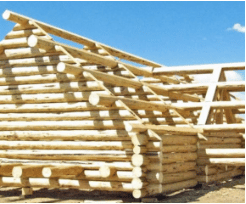
A full round log keeps the tree’s natural cylindrical shape on both the inside and the outside of the wall, while a D-log is milled flat on the interior face so it forms a capital “D” in cross-section. Full round is the handcrafted, chink-style look that has been built in North America for more than 400 years. D-log is the milled, uniform, faster-to-stack alternative. Frontier Log Homes has hand-peeled and saddle-notched full round logs in Montrose, Colorado since 1977, and builds custom homes and kits for clients across the United States.
When it comes to the aesthetics and build quality of a log home, there is a history behind the craftsmanship that is still used to this day. Many of the historic wood homes in the United States come from Scandinavian construction that was brought to the Americas in the early 17th century. The original method of using full round logs with an axe and a draw knife is the type of construction that has been passed down over the years, and it is the root of how Frontier Log Homes still builds to this day.
Since the 1920s, milled and manufactured logs have become popular. It can often be difficult to understand the difference in quality between both styles. By looking at the shape, you can see a lot about the construction and the quality of the build—specifically the difference between a D-log and a full round.
Full Round vs D-Log: What They Look Like
One of the differences in the methods of crafting this type of home is the signature shape of the wood. Alternatively, D-shaped logs are milled, stacked, then erected to complete the structure. An easy way to see the difference between a round and a D-log is to imagine cutting it open to look at the rings inside. A round log will show you every ring in its entirety. If you were to look at the rings on a D-log, you would see some of the rings are cut off, because the interior side of the piece of wood has been trimmed flat. The log has a distinct uppercase “D” shape, hence its name.
With a D-log, larger timbers are sent through a mill, removing the bark and some of the trunk’s width, reducing all of the timbers down to a uniform size and shape.
The Authentic Handcrafted Shape of a Full Round Log
A full round log is a sign of a hand-hewn and hand-built home. When it comes to a more natural and historical look, this is the way to go. A craftsman peels the bark off of each individual timber with a draw knife, allowing the natural shape to remain intact. It creates that signature look of a chink-style cabin that has been built in the United States for over 400 years.
With full round logs, the build is completed one at a time, and it will be unique to your personal style and needs. If a full round log home is the style you want, call one of the experts at 970-249-7130.
5 Simple Ways to Choose Between Full Round and D-Log
Both styles produce a solid log wall. The decision comes down to five practical trade-offs, and only one of them is about looks.
1. Authenticity and Appearance
A handcrafted round wall reads as handmade because it is. Every log keeps its own taper, its own diameter and its own character marks, so no two walls are identical. A D-log wall is uniform by design: every course is the same height, the interior face is flat, and the result looks closer to conventional millwork. If the reason you want a log home is that it should look like a log home from both sides, full round is the answer.
2. Interior Wall Space and Furniture
This is the honest argument for D-log. A flat interior face lets bookcases, cabinets and artwork sit tight against the wall. With round logs the interior surface undulates, so furniture stands slightly off the wall and hanging things takes more thought. Some owners love that; others find it inconvenient in a kitchen or a home office.
3. Chinking and Sealing
Round-profile walls are typically chink-style, with a visible band of sealant between courses. That band is part of the aesthetic and part of the weather barrier. D-logs are usually milled with a tongue-and-groove or lap profile that closes without visible chinking. Neither is maintenance-free. Our guide to chinking log homes explains what the joint actually does and how often it needs attention.
4. Thermal Mass and Energy Performance
More wood means more mass. A round log is thickest at its centerline, so an average 10-inch round wall carries more material than a D-log milled to a uniform 8 inches. That extra mass stores and releases heat, which is why log walls outperform their rated numbers in climates with big day-to-night temperature swings. The details are in our breakdown of the R-value of wood.
5. Cost, Labor and Lead Time
Milled D-logs are produced on a production line, so they are usually cheaper per linear foot and faster to stack on site. Handcrafted logs are scribed and notched individually by hand, which takes skilled labor and time in the yard before anything ships. You are paying for craftsmanship and for a wall that cannot be reproduced by a machine.
How a Full Round Log Home Is Built
Frontier hand-peels each log with a draw knife, scribes it to the log below so the two surfaces match along their entire length, and cuts a saddle notch at every corner. The whole shell is then dry-fit in the Montrose yard, every piece is numbered, and the building is taken apart and loaded for delivery. On your site it goes back together the way it came apart.
That dry-fit step is what separates handcrafted work from a stack of logs on a truck. It is also why a handcrafted shell can be raised in days once it arrives. You can buy the shell as a log home kit for your own contractor to finish, or have Frontier handle the whole build.
Species, Moisture and Long-Term Stability
Most Frontier full round work uses standing dead lodgepole pine, which has already dried on the stump. Dry logs settle less, check less and hold their scribe lines. Green logs of any profile will shrink, which is why settling allowances above windows and doors are engineered into the plan rather than improvised on site. The USDA Forest Products Laboratory publishes the underlying research on wood moisture and dimensional change.
Whichever profile you choose, the structure has to satisfy ICC 400, the standard for the design and construction of log structures published by the International Code Council. Any competent log builder will already be designing to it.
Full Round Log FAQs
Is a round log home stronger than a D-log home?
Both are structurally sound when built correctly. A round wall generally contains more wood by volume at the same nominal diameter, which adds mass, but strength in a log building comes mostly from the corner joinery and the engineering, not the profile.
Do handcrafted round logs need more maintenance?
Roughly the same as any log wall: inspect annually, and refresh stain or sealant every three to five years depending on sun and weather exposure. Chink-style joints on a round wall get inspected at the same time.
Are handcrafted round logs more expensive?
Usually yes, because the work is done by hand. The premium buys individual scribing, saddle-notched corners and a wall that no mill can duplicate. How much more depends on diameter, species and how complex the floor plan is.
Can you mix round and D-log profiles in one house?
It is possible but rarely satisfying. The two profiles read very differently in the same space. A more common approach is a round-log exterior shell with conventional framed interior partitions.
What size are full round logs?
Frontier’s handcrafted logs commonly average around 10 inches in diameter, running from roughly 12-inch butts down to 8-inch tips, because the natural taper of the tree is preserved rather than milled away.
Does Frontier build outside Colorado?
Yes. Frontier Log Homes designs and handcrafts full round log homes and kits in Montrose, Colorado and delivers them throughout the United States. Call 970-249-7130 to talk through your plan.