
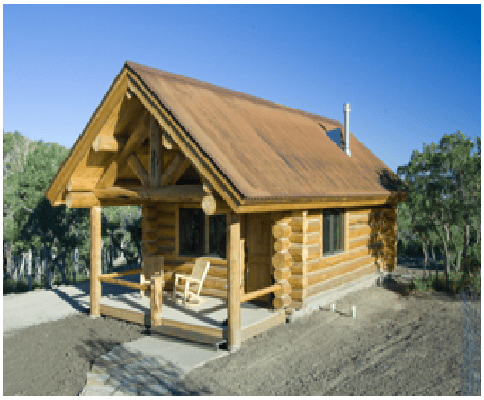
A tiny cabin is a compact log structure, usually under about 1,000 square feet, that can be built from a handcrafted kit and run entirely off-grid on solar power, captured rainwater and a composting toilet. It costs less to build, less to heat and less to maintain than a full-size house, and it can serve as a home, an office, a guest suite or a hunting camp. Frontier Log Homes has handcrafted log homes and log home kits in Montrose, Colorado since 1977 and ships tiny cabin kits throughout the United States.
Whether you’re wanting to live a minimalist lifestyle, want a second home deep in nature, or need sporadic hunting cabins for comfort during hunting season, building a tiny cabin is a great way to go off-grid and connect with nature.
Why Should You Build a Tiny Cabin?
Building a log home with a tiny cabin kit has several advantages.
- There’s a lower cost. Because of the smaller size, there are fewer costs. Not only is there less cost for building materials, you won’t need to buy as much furniture or supplies to fill your new tiny home. If you want an eco-friendly home, it also lowers your energy costs!
- They can be eco-friendly. Log buildings can be as off-grid as you desire. With a tiny log home, you can use solar or wind sources for power, have a rainwater catch and filtration system, a compost toilet, and more.
- It helps declutter. If you struggle with having too many knick-knacks around your home, a small log home aids in decluttering and makes it easier to live minimally.
- There’s less to clean! Less square footage means less mess and not as much to clean.
- It’s low maintenance. There’s not as much annual cleaning or exterior areas to check up on and repair due to the lower square footage.
- Be mobile! You won’t have to stay in the same spot. Because of the smaller size, these homes could be constructed on a trailer.
6 Ways to Use a Tiny Cabin
There are a lot of possible uses for small cabins rather than just using it as a home. You could use it:
- As an office: If you need a quiet, secluded place to work or spend some time alone, a tiny cabin is a good way to do it!
- As a vacation home: Go off-grid and connect with nature in your own, personalized vacation home.
- As a short or long-term rental: People love to travel, and what better place to stay than a tiny cabin?
- As a hunting cabin (or many hunting cabins): Using a small cabin for hunting can be the perfect place to store supplies or settle down for the night while on a hunting trip. Building multiple structures across a property could be even more beneficial as you move from place to place and you could rent them out to other hunters.
- For traveling: Because of the possible mobility, you can feel free to explore to your heart’s desire.
- As a guest house: A tiny cabin in the back corner of a property gives visiting family a private place to stay without adding a bedroom wing to the main house.
- As a short-term rental: A small, well-built log cabin on scenic acreage rents well, and a kit build gets it earning far sooner than a custom home would.
What Comes in a Tiny Cabin Kit
A handcrafted kit is not a flat-pack shed. Frontier hand-peels and saddle-notches every log, dry-fits the entire shell in the Montrose yard, numbers each piece, then takes it apart and ships it. What arrives on your site is a numbered log package with the wall logs, roof system logs, and the joinery already cut. Your contractor supplies the foundation, roof covering, windows, doors, mechanical systems and interior finishes.
That split is what makes a tiny cabin realistic for owner-builders. The hardest part, the log work, is done by people who do it every day, and the rest is ordinary construction any competent local builder can handle. Browse the available log home kits to see the range of footprints.
What Drives the Cost of a Tiny Cabin
Square footage is the obvious lever, but it is rarely the biggest one. These four factors move a tiny cabin budget more than size does.
Site Access and Sitework
A buildable pad, a driveway a crane can reach, and a place to put the excavated dirt. Remote mountain lots often cost more to prepare than the cabin shell costs to buy.
Foundation Type
A pier foundation on a level site is inexpensive. A full frost-depth foundation on a slope is not. Ask this question before you buy the land, not after.
Utilities or Off-Grid Systems
Running power, water and septic to a remote parcel can cost more than the cabin. That is exactly why so many tiny cabin owners go off-grid instead.
Interior Finish Level
Two identical shells can finish out at wildly different numbers depending on cabinetry, flooring and fixtures. In a small footprint every finish choice is highly visible, so people tend to spend up. Budget accordingly, and look at log home financing options early.
Going Off-Grid in a Tiny Cabin
Small footprints make off-grid living genuinely practical, because the loads are small enough that renewable systems can carry them.
Power. A modest rooftop or ground-mount solar array with a battery bank will run lights, a well pump, a laptop and a refrigerator in most of the country. The Department of Energy guide to planning a home solar electric system is the right place to start sizing. Whatever you install, the cabin still needs code-compliant log cabin wiring.
Water. Rainwater catchment off a metal roof, stored in a cistern and run through filtration, covers a tiny cabin easily. Check state rules first, since rainwater harvesting is regulated differently from state to state.
Waste. A composting toilet eliminates the septic system entirely, which is often the single largest off-grid savings. Where a septic system is required, the EPA septic system resources explain the options.
Heat. A single wood stove will heat a well-built tiny cabin through a Colorado winter. Log walls store that heat and release it slowly, which is why small log cabins hold temperature better than small frame ones.
Permits and Codes for a Tiny Cabin
Tiny does not mean exempt. Most jurisdictions still require a permit, an inspection schedule and a code-compliant structure. Many have adopted Appendix Q of the International Residential Code, which relaxes ceiling height, loft and stair requirements for dwellings under 400 square feet. Your county building department will tell you in one phone call which version of the International Code Council codes it enforces.
Two questions decide most tiny cabin projects: is the parcel zoned for a dwelling, and is there a minimum square footage in the zoning code? Ask both before you buy. Our guide to navigating building codes covers what happens next.
Tiny Cabin FAQs
How small is a tiny cabin?
There is no legal definition, but most people mean something between roughly 200 and 1,000 square feet. Appendix Q of the residential code draws its line at 400 square feet, and many counties set a zoning minimum somewhere in that range.
Can you live in a tiny cabin year-round?
Yes, and log construction is well suited to it. Solid log walls store heat, so a small cabin with a wood stove and a properly insulated roof stays comfortable through hard winters.
Is a tiny cabin cheaper than a tiny house on wheels?
Usually not per square foot, but it holds value differently. A cabin on a permanent foundation is real property that can be appraised, insured and financed like a house. A trailer-mounted tiny house is generally treated as a vehicle.
Do I need a contractor to build a tiny cabin kit?
You need someone licensed to pull the permit and handle the foundation, roof and mechanical work in most jurisdictions. Plenty of owners act as their own general contractor and hire the trades directly.
How long does it take to build a tiny cabin?
The log shell typically goes up in days once it is on site, because it was already fit together in the yard. Foundation, roof, utilities and interior finish are what set the schedule, generally a few months.
Can a tiny cabin be moved later?
A cabin built on a trailer chassis can. One built on a permanent foundation is meant to stay. Decide which you want before the foundation is poured, because it changes the design.
Ready to Build Your Tiny Cabin?
Frontier Log Homes handcrafts tiny cabin kits and full custom log homes and delivers them across the United States. Call 970.249.7130 to talk through your lot, your budget and which footprint fits.