
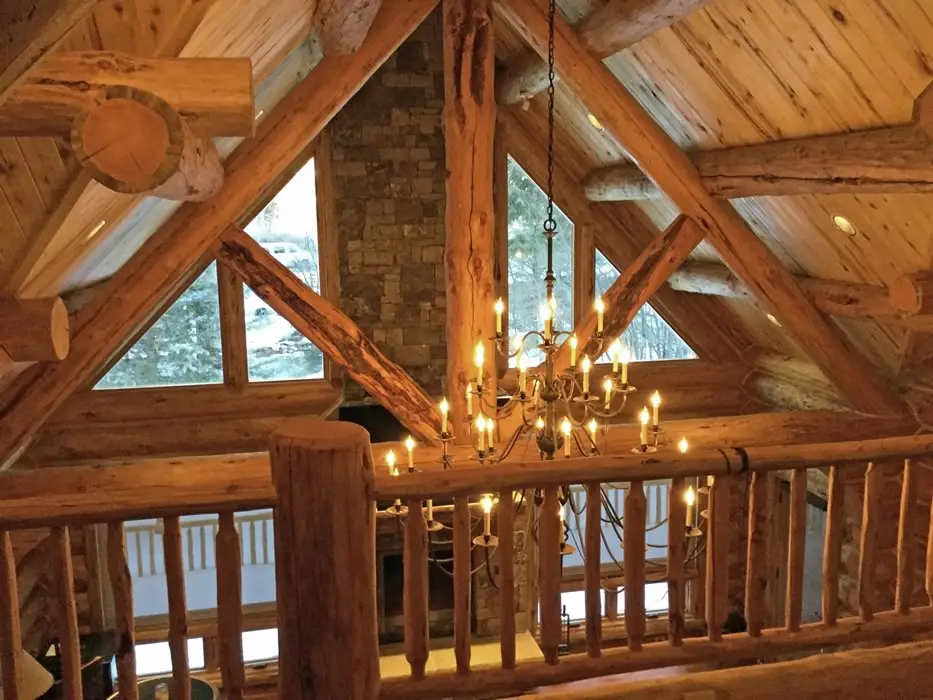
Timber frame homes cost roughly the same as a comparable custom home in most markets — often five to fifteen percent more for the shell, and occasionally less once you account for speed and energy use. The reputation for being expensive comes from three specific line items, not from timber framing itself. Below we break down exactly where the money goes, where it comes back, and seven practical ways to control what timber frame homes cost on your build. Frontier Log Homes has been handcrafting log and timber homes in Montrose, Colorado since 1974.
| What raises the price | What brings it back down |
|---|---|
| Premium species and large timber sections | Standard plan instead of a full custom design |
| Hand-cut joinery and carved details | Simpler joinery with fewer decorative elements |
| Structural insulated panel enclosure | Lower heating and cooling bills for decades |
| Complex rooflines and curved timbers | Rectangular footprint and simple gable roof |
| Custom windows in unusual shapes | Stock window sizes in standard openings |
| Building everything at once | Phasing the build and expanding later |
Do Timber Frame Homes Cost More Than Conventional Homes?
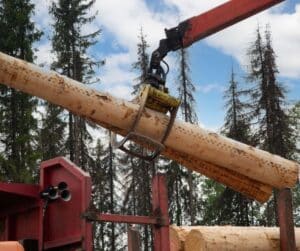
Timber frame homes are beautiful to look at and remarkably comfortable to live in, which is why so many people choose one over conventional stick framing. They are also not new. Timber frames were the first houses American settlers built in the 1600s, and some of those buildings are still standing. Technology has since made frames sturdier, far more energy efficient, and much easier to customize.
So why the reputation? Because a timber frame is exposed. Every joint is visible, so every joint has to be right, and that shows up in the labour line of an estimate. Compared honestly against a custom home of the same size and finish level — not against a builder-grade tract house — timber frame homes cost about the same, with the difference concentrated in the shell rather than spread across the whole project.
3 Reasons Timber Frame Homes Cost More
Superior Quality Wood
A timber frame home is built with load-bearing exterior walls and interior timber frames that carry the structure. For maximum strength and safety, producers select the best available wood: cedar, Douglas fir, cypress, and several oaks. High-quality timber protects the foundation, roof, and walls and gives the house a far longer service life. It also means timber frame homes cost whatever the lumber market says on the day you order, so species choice and section size move your budget more than almost any other decision.
Craftsmanship
Timber frames are defined by their joinery. Carpenters and wood designers cut each member, then dry-fit the entire frame in the assembly yard to confirm every joint seats properly before it is taken apart and raised again on site. That process takes time, skill, and expertise, and it is the main reason timber frame homes cost more per square foot of shell than a nailed platform frame.
Insulation
Modern frames are usually enclosed with structural insulated panels, which deliver excellent insulation and very low air leakage. Panels cost more up front than batt insulation in a stud cavity. We still tell clients not to economise here: the U.S. Department of Energy is blunt about how much of a home’s lifetime cost is heating and cooling, and a tight envelope pays that back every winter.
Where Timber Frame Homes Cost Less
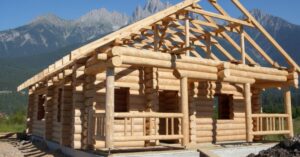
Estimates rarely credit the other side of the ledger, but it is real.
Speed on site. A pre-cut, pre-fit frame goes up in days rather than weeks. Fewer weeks of crew time, crane time, and construction financing is money straight back into the project.
Fewer interior structural walls. Because the frame carries the loads, interior partitions are optional. Moving a wall later costs almost nothing, which is a genuine long-term saving most owners never price in.
Lower operating cost. A panel-enclosed frame is unusually airtight, so timber frame homes cost noticeably less to heat and cool than a conventional house of equal size.
Durability. Heavy timber does not rot out, sag, or need replacing on a schedule. Research from the USDA Forest Products Laboratory on large-section wood performance is a big part of why these buildings survive centuries.
7 Smart Ways to Lower What Timber Frame Homes Cost
1. Build Smaller
The simplest lever by far. Owners routinely build more house than they use. Walk through your daily routine room by room before you settle on a plan; many families find they live just as comfortably in a smaller, better-designed home.
2. Plan for Future Expansion
You can design the full home and build only part of it now. Pour the foundations and rough in the connections for the later phase, finish the section you need, and move in. Phasing is one of the most effective ways to make timber frame homes cost what you can actually spend this year.
3. Build Some Parts Conventionally
Garages, sheds, mudrooms, and guest suites do not need exposed joinery. A hybrid approach uses decorative timber accents to keep a unified look for a fraction of the price, and our hybrid log and timber builds do this routinely.
4. Start From a Proven Plan
Full customisation is the frame’s great advantage and also its most expensive one, since timbers, windows, and doors all have to be made to specification. Choosing a ready-made kit or an existing plan with modest tweaks saves a significant share of the total. Browse our log and timber home kits to see how far a standard footprint can be adapted.
5. Pick One or Two Showpieces
Carved staircases, king post trusses, arched cornices, and cathedral ceilings are gorgeous and labour-intensive. Choose the one or two elements that genuinely move you, keep the rest straightforward, and you get the drama without the whole bill.
6. Watch the Finishes
Kitchens, bathrooms, fireplaces, floors, and windows drive budget in any house. Timber finish is its own decision: smooth, rough-sawn, and hand-hewn each carry a different labour cost. Odd-shaped windows cost more to build, insulate, and install than stock rectangles. See our log home kitchen ideas for ways to get character without custom cabinetry everywhere.
7. Respect the Site and the Calendar
A steep or remote lot adds excavation, access, and utility cost before a single timber arrives, and winter starts in the mountains slow everything down. Choosing a buildable site and a spring raising date quietly reduces what timber frame homes cost more than most design decisions do.
Timber Frame Homes Cost: Questions We Get Asked
How much do timber frame homes cost per square foot?
It depends far more on finish level and location than on the frame. The frame and enclosure package is typically a quarter to a third of the finished project, and the rest is the same site work, mechanicals, and finishes any custom home needs. Our cost breakdown and current build cost guide give real ranges.
Is a timber frame cheaper than a full log home?
They are close, and the answer swings with species and log profile. A timber frame uses less wood volume but more joinery labour. Our comparison of timber frame and post and beam construction explains the trade-offs.
Do timber frame homes cost more to insure?
Generally no. Heavy timber chars slowly rather than failing quickly, which underwriters understand. Wildfire exposure drives rural premiums far more than framing type; see fire-resistant cabin design.
Are they harder to finance or appraise?
They need an appraiser who understands custom construction, and comparable sales can be thin in rural markets. Working with a builder who supplies complete plans and specifications early makes the process straightforward.
Do timber frame homes cost more to maintain?
No. The frame is protected inside the enclosure, so there is no exterior wood to re-stain unless you have exposed porch timbers. Maintenance looks much like log home upkeep, minus the walls.
Can a timber frame be built anywhere?
Almost. Engineering adjusts for snow, seismic, and wind loads, and we build to the adopted local code. We ship nationwide from our Montrose yard; see where people are building.
Timber Frame Homes Are Adjustable. That Is Their Beauty
Timber frame homes can run slightly above conventional construction, and in exchange you get craftsmanship, energy performance, and a structure that outlives its owners. Because the frame carries the loads, the design bends to almost any need and any budget — which is why what timber frame homes cost is more a decision than a fixed number.
Frontier Log Homes has been handcrafting log and timber homes in Montrose, Colorado since 1974. Contact Frontier Log Homes or call 970-249-7130 and we will price your plan honestly, then show you where to trim it.