
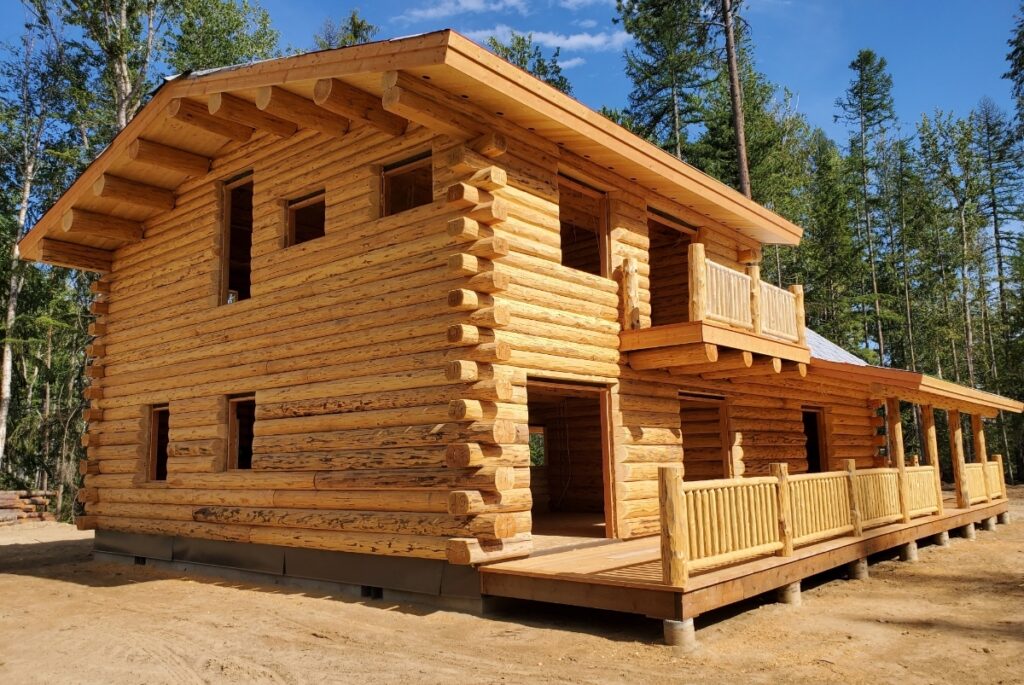
Log cabin kits are worth it when you bring real building skill, time, and patience to the project; they are the wrong choice if you expect flat-pack furniture assembly or a hands-off build. A kit lowers your up-front cost by moving labor and risk onto you. Below is an honest look at both sides, including the seven pros and cons that decide most projects. Frontier Log Homes has designed and handcrafted log homes and log cabin kits in Montrose, Colorado since 1977.
What Is a Log Cabin Kit?
A log cabin kit is a packaged set of parts for building a log home. The manufacturer mills every piece to your chosen design, numbers it, and ships it to your site. Log cabin kits are engineered before they leave the shop, which is exactly why they go up faster than a stick-built house.
What Log Cabin Kits Include
- Logs: pre-milled or handcrafted to your design. They form the walls.
- Windows and doors: pre-fabricated and sized to the log openings.
- Roofing and floor joists: cut beams and roofing material for structure and weather protection.
- Interior wall panels and stair systems: standardized fittings from most vendors.
- Assembly guide: step-by-step instructions and a numbered log layout.
Log cabin kits vary widely by manufacturer, so confirm the full parts list in writing before you buy.
What Log Cabin Kits Do Not Include
This is where most budgets break. Nearly all log cabin kits stop at the shell package, which means you are still responsible for the land, the site work, the driveway, the well and septic, the foundation, and every mechanical system. Plumbing, wiring, HVAC, insulation, drywall, flooring, cabinets, fixtures, permits, engineering stamps, and the crane or lift used on assembly day are almost never in the box. Freight is usually quoted separately too.
Read the exclusion list before the inclusion list. A kit that looks $30,000 cheaper often just excludes $60,000 of work that the other supplier included.
Log Cabin Kits: Pros and Cons at a Glance
| Pros | Cons |
| Lower up-front cost | Demands real building skill |
| Faster assembly than a traditional build | Quality is hard to check when ordering online |
| Pre-cut, numbered parts reduce guesswork | Shipping and site work add meaningful cost |
| Customizable layouts and finishes | Mistakes are hard to fix once logs are cut |
Pros of Log Cabin Kits
Pro 1: Lower Cost
Cost is the main draw. Log cabin kits run roughly $50 to $100 per square foot for the package. A prefab or modular cabin runs $100 to $250 per square foot, and a fully custom build runs $250 to $500. If you assemble the shell yourself, you also save the labor line. See our log cabin cost breakdown for the complete picture, including the soft costs a kit price never shows.
Pro 2: Simpler, Faster Build
The hard engineering is finished before the kit ships. Logs arrive pre-cut and numbered to your plan, so there is far less guesswork on site. Many shells go up in a few weeks, while a traditional build can take several months to reach the same point. Less time exposed to weather means less risk to the structure and an earlier move-in date.
Pro 3: Customization
Log cabin kits do not lock you into one look. You choose the layout, add wood detailing, raise the ceiling, or size up the windows for the view. A kit is a starting point you finish to your own taste, and a good supplier will adjust the plan before milling begins. Browse popular log home styles to see how different the same square footage can feel.
Pro 4: Predictable, Pre-Engineered Materials
Because the package is cut in a controlled shop, the wood is graded, dried to a known moisture content, and matched to the span calculations on your plan. That predictability matters for permitting. Your building department will check the plan against the I-Codes adopted in your county, and a stamped kit package usually moves through review faster than a one-off design drawn on site.
Cons of Log Cabin Kits
Con 1: Skill Requirement
Assembly is a real construction project, not flat-pack furniture. You need working knowledge of framing, fasteners, flashing, and load paths to keep the structure sound. A garden shed is one thing; a full log cabin is another. Be honest about your skill level before you order, because construction mistakes in logs are expensive to undo. If you have doubts, hire an experienced builder for the parts beyond your level.
Con 2: Quality Control
Quality is harder to verify when you buy log cabin kits online. You may have limited contact with the seller, so problems surface late. Once logs are cut to length, changes are close to impossible. Ask for references, ask to see a finished home, read reviews, and pick a supplier with a track record you can actually check.
Con 3: Added Costs
The sticker price usually leaves out the rest of the job. Freight is the big one, since logs are heavy and bulky, and truckload rates commonly land between $7 and $12 per mile. Delays during the build add carrying costs, and a stalled project may need a professional crew to finish. Insulation and air sealing are also on you, and the Department of Energy insulation guidance is a good place to start on those numbers.
How to Judge Log Cabin Kits Before You Buy
Compare packages line by line rather than by headline price. Ask each supplier for the species and grade of logs, the wall thickness, the corner style, the moisture content at shipping, the settling allowance built into the plan, and the exact list of what arrives on the truck.
Then ask two questions that separate serious suppliers from brokers: who engineered this plan, and who answers the phone on assembly day? Log cabin kits from a real shop come with drawings you can hand to an inspector and a person who knows your specific package. Kits from a reseller often come with neither.
Assembly Timeline, Step by Step
Knowing the order of operations is what keeps a self-build from stalling. Site work and the foundation come first, and they have to be square and level within a very tight tolerance because every numbered piece above assumes it. Once the deck is framed, the wall stack begins at the sill and works up course by course, with fasteners and gaskets installed exactly as the drawings specify.
Next come the roof structure, sheathing, and a weather-tight roof covering, which is the milestone that protects everything you have paid for. Windows and doors follow, then rough plumbing, wiring, and mechanicals. Insulation, interior finishes, flooring, and cabinets close out the job. Inspections happen throughout, not at the end, so build the schedule around your inspector rather than around your weekends.
The single biggest scheduling mistake is ordering the package before the site is ready. Logs sitting on a trailer or under a tarp are logs absorbing moisture and losing money.
Settling: The Detail Most Kit Buyers Miss
Solid wood walls shrink and compress as they release moisture, and a wall can lose one half to one inch of height per foot of wall over the first few years. That movement is normal and predictable, and it is designed for with slip joints at posts, oversized openings above windows and doors, screw jacks, and stair details that are not rigidly fastened to a moving wall.
If a package does not show those details on the drawings, the supplier has not thought the problem through. Drywall cracks, sticking doors, and plumbing pulled out of alignment all trace back to a shell that was assembled as if wood never moves. Our guide to how log homes settle covers what to expect year by year, and the threats log homes face explains why moisture control matters so much during and after assembly.
Handcrafted walls and milled walls settle differently, so the allowance on your plan should match the product you actually bought. Ask for the number in inches, in writing.
Financing, Insurance, and Appraisal Realities
Lenders treat a shell package differently than a finished home. Many construction loans release funds in draws tied to completed stages, and a homeowner acting as their own general contractor can face a smaller loan, a larger down payment, or a requirement to name a licensed builder of record. Ask your lender how they handle owner-builders before you sign a supply contract.
Insurance follows the same logic. A partially assembled shell needs builder risk coverage, and carriers will ask who is on site and whether the structure is weather-tight. Appraisal is the last piece: comparable sales for log construction can be thin in some markets, so plan for the possibility that the appraised value lags your invested cost in the first year.
Are Log Cabin Kits Worth It?
Log cabin kits reward skill, time, and planning. For a confident builder, a kit saves real money and delivers a cabin you put together with your own hands. For someone short on building experience, those savings can disappear into fixes, delays, and rework.
If you want the log look without the on-site risk, a turn-key build hands the whole job to a crew. A dry-in package sits in the middle: we get the shell weather-tight, and you finish the interior at your own pace. Compare all three in our modular log homes versus log cabin kits guide.
Log Cabin Kits FAQ
How much do log cabin kits cost?
Most log cabin kits run $50 to $100 per square foot for the shell package. A 1,500 square foot kit therefore lands around $75,000 to $150,000 before land, foundation, utilities, mechanicals, and interior finishes.
Can one person assemble a log cabin kit?
Not safely. Logs are heavy and often need a lift or crane. Plan on a small crew plus equipment for the wall stack and the roof, even on a small cabin.
How long does it take to build a log cabin kit?
The shell typically goes up in two to six weeks with a competent crew. Getting from shell to move-in usually takes another four to eight months once mechanicals, insulation, and finishes are done.
Do log cabin kits meet building code?
A properly engineered kit does. Your county adopts a version of the I-Codes and reviews your stamped plans against it, so ask your supplier for engineering that matches your snow, wind, and seismic loads.
Are log cabin kits cheaper than a custom log home?
Yes on the package price, and often no on the finished price. Once you add site work, labor, and finishes, a well-managed custom log home can land close to a kit that ran into delays.
What size log cabin kit should I choose?
Start from how you will actually live in the home, not from a square footage target. Our sizing pages help: under 1,500 sq ft, 1,500 to 2,500 sq ft, 2,500 to 3,500 sq ft, and 3,500 sq ft and up.
Do log cabin kits come with a warranty?
Reputable suppliers warrant the materials and the milling, not your assembly. Get the warranty terms in writing before you pay a deposit, and confirm what happens if a log arrives damaged.
Get Log Cabin Kits From Frontier Log Homes
Not sure a kit fits your project? Our team will walk you through it honestly, including the times we recommend a turn-key build instead. Frontier Log Homes has handcrafted award-winning log homes, commercial buildings, and log cabin kits since 1977, with more than 40 years of experience behind every package we ship.
We build fully custom log cabin kits sized to your family, your land, and your plans, from a small retreat to a full family home. Contact us to find the right fit, or start with the design and let the kit follow the plan.
Weighing a kit against a full build? See what kit buyers said afterward in our client reviews.
If a kit will not fit your site, custom log home design will. That is the choice most owners are really making.